We’ve written before about the Virtual Museum that can be found on the Supporters Club website, and we would really like to hear from any supporters who might have Rovers memorabilia they would like to share with others.
There’s no need for the items to leave your house, just take a photo of your collection, or scan the items if they are programmes or photos and send them to infobrheritagesociety@gmail.com
To kick off supporter contributions Supporters Club secretary and Club Historian Keith Brookman will, over the course of the next four articles, showcase some of the items he has collected over the years.
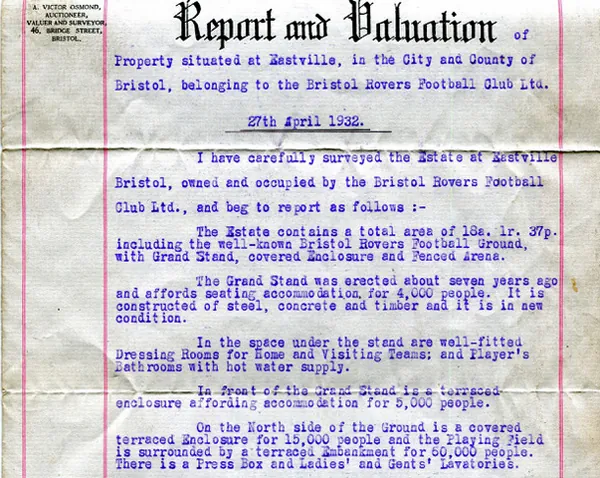
His selections for today are the Memorandum of Association of the Eastville Rovers Football Club and the report and valuation of Eastville.
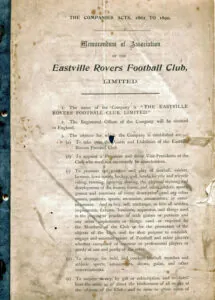 The Eastville Rovers document is in surprisingly good condition given that it’s dated 26th March 1897. The names, addresses and occupations of the Subscribers (Shareholders) are listed as follows – we wonder if any of their descendants are still living in the Bristol area and could tell us more about them.
They were; Samuel Sinclair Rinder (Ostrich Feather Manufacturer), Samuel Joy (Licensed Victualler, Wagon & Horses Hotel), William Henry Brown (Gentleman), Frederic Walter Hunt (Licensed Victualler, Black Swan Hotel), Albert James Beavan (Building Contractor), Henry James Horsey (Commercial Clerk) and Imlah Hewys (Coal Merchant).
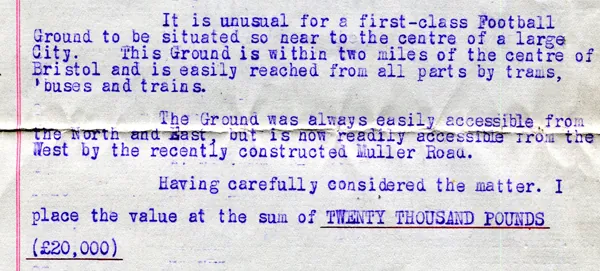
The Report and Valuation Document is dated 27th April 1932 and the opening paragraph of the report says; ‘Property situated at Eastville, in the City and County of Bristol, belonging to the Bristol Rovers Football Club Ltd.’ It concludes by saying; ‘It is unusual for a first class Football Ground to be situated so near to the centre of a large City. This Ground is within two miles of the Centre of Bristol and is easily reached by trams, buses and trains.
‘Having carefully considered the matter, I place the value at the sum of TWENTY THOUSAND POUNDS (£20,000)’ The report was signed by A. Victor Osmond, Auctioneer, Valuer and Surveyor, 46 Bridge Street, Bristol.
Seven years later, in 1939, Rovers found themselves in financial difficulties and Secretary Syd Hawkins, on the instruction of Chairman Fred Ashmead, wrote to the Greyhound Company, who were operating twice weekly meetings under a 21 year lease, giving them first refusal to purchase the site.
Ashmead appears to have independently agreed to sell the site without due consultation with his fellow Board members, some of whom were against the proposal. However, following lengthy negotiations, the Greyhound Company paid the Football Club £12,000 (£7,000 less than the 1932 valuation!) for the site and gave Rovers a 21 year lease to continue playing at Eastville.
Check out the virtual museum at www.bristolroverssc.co.uk